April 17, 2026
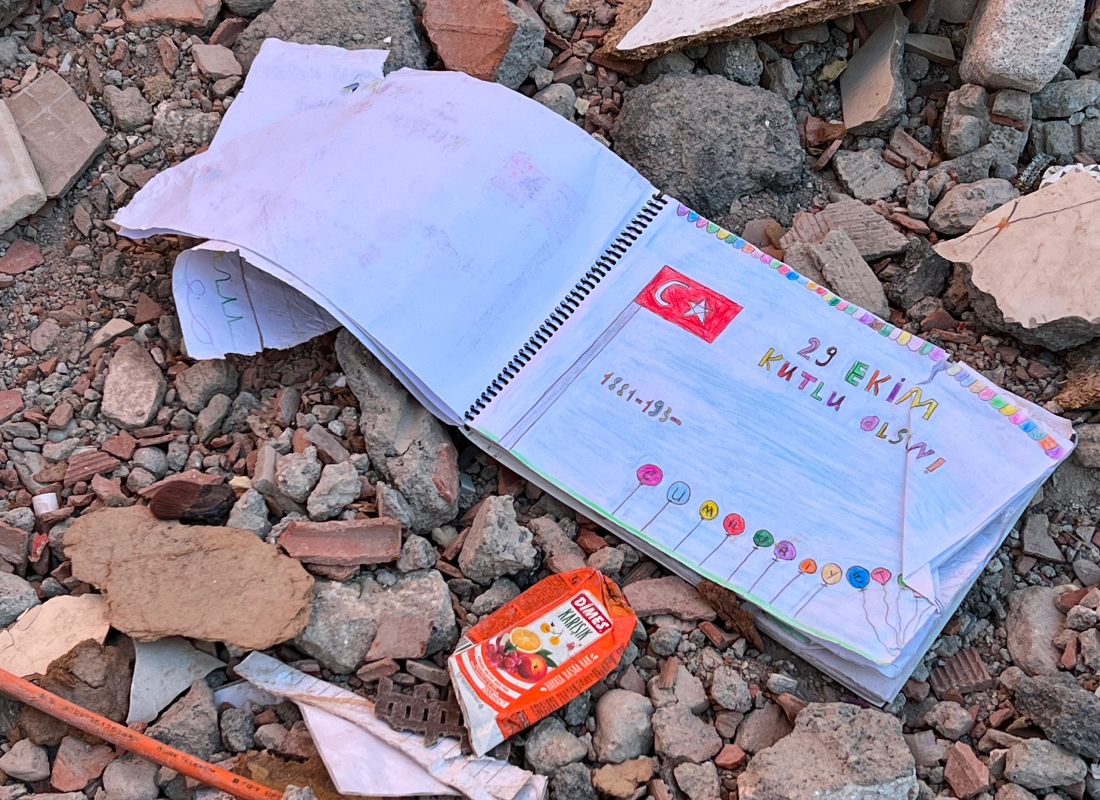
Helfende Hände was quickly on site after the earthquake in Turkey, bringing aid supplies to remote villages where help often arrives too late – Operations Manager Monte E. Wilson reports from the sea of rubble…

Manila greets us like a seemingly endless monster of a city: dirty, smelly, chaotic and deafeningly loud. The boundaries between the city, slums and suburbs blur in the noise of the metropolis.
Our project coordinator Bryan picks us up to take us to the girls’ home. Goats roam the country roads outside the city. In the villages, we pass tiny shops packed to the ceiling and people repairing household appliances and motorcycles in the middle of the chaos. Inside our vehicle, the street noise is barely audible. The bustle passes us like a silent film. Before reaching the site, we cross a slum of huts cobbled together from corrugated metal, wooden slats and anything else people could find.
Then the gate opens onto another world. The center in Laguna is a beautiful, quiet and peaceful place surrounded by greenery. Five small houses stand on the walled grounds. By Philippine standards, this is a good standard of living – although to Western eyes it still looks very simple and weathered by the tropical climate. But for the children here, this wall marks the boundary between fear and complete safety.
As soon as we arrive, children from the surrounding community welcome us. They begin the day by dancing together – a carefree energy that immediately lifts our spirits.
The girls’ welcome at the home is unforgettable: as a sign of honour and respect, they gently press our hands to their foreheads. At first they are extremely reserved, almost silent, and speak softly to us in English. In the oppressive heat and very high humidity, we are drenched in sweat. ‘Why are your faces so red?’ they ask shyly, giggling.
They proudly show us their living quarters. Two or three girls share a room. Everything is tidy, clean and homely, although very basic and worn. The bathrooms and kitchens are unattractive – yet even then we know that this is infinitely more than most children outside will ever have.
After the staff and Bryan have told me more about the organisation, it is time to have lunch together – an absolute turning point.
Here at the home, people traditionally eat with their hands from banana leaves. When we visitors try to get rice and noodles into our mouths with our fingers without making a mess, we are spectacularly clumsy. What could have been an awkward moment becomes the perfect icebreaker. The girls double over with laughter. Their shyness disappears and they visibly open up.
In the afternoon, the common room turns into a karaoke stage. When the microphone reaches me and I give it everything I have, a storm of delight breaks out. The whole house dances; some girls play chess. For one precious hour, these girls can simply forget their traumatic memories and once again be what they truly are: children.
The shadow in their eyes: Most of the time, they seem like completely ordinary children. But if you look closely, you notice how, in the middle of laughter, a dark shadow can suddenly fall across a face. Their gaze instantly becomes empty and infinitely sad. One little girl is unable to shake off this sadness all day.
Behind the afternoon’s happiness lies profound suffering. Girls who have experienced severe abuse live in two of the five houses. One house is home to 15 younger children from the age of six or seven who receive intensive care; the other houses the older, more independent girls up to the age of 14.
The girls were deliberately brought here from Manila so that they would not feel the impulse to run away, but above all to protect them from their former abusers – who are often their own fathers or uncles. Once a week, they may speak with their families by phone. Some feel homesick; for others, their own family is the painful reason they are here at all.
As we say goodbye, we hand out small gifts. The notebooks in particular bring tremendous joy. The girls write a lot – it is their way of processing what cannot be put into words.
Immediately beyond the center’s secure gate, the slum begins again. It smells of sewage, the lanes are cramped and animals are tethered everywhere. We balance across shaky walkways between stilt houses. Beneath us is dirty, brackish water – floods lasting for weeks are a regular and exhausting problem here. Huge families often share a tiny, cave-like dwelling. A married couple who can use a six-square-metre room for themselves is already considered well-off.
Here we meet a grandmother from the village. She is the watchful eye of the neighbourhood. She pays close attention: Which children are not getting enough to eat? Who shows signs of violence at home? Children play outside in the dirt and rubbish. Look again and they play just like children in our sandpits – except their sandpit consists of the waste of civilisation.
We then reach a dusty football pitch. Young volunteers from the community perform a puppet show for the village children. Its subject is as important as it is life-saving: ‘Good touch, bad touch.’ The children – aged two to 13, with the older ones tenderly holding the little ones’ hands – learn through play where their boundaries are and where they can find help: from their mother, their teacher or the center’s team.
On another day, we visit the nutrition programme in Payatas and meet nine-year-old Chloe (name changed to protect her). A social worker takes her home, and we accompany them. The social worker keeps a protective arm around Chloe the entire time. Chloe’s home is a tiny room where her mother sells food and where the whole family sleeps at night.
The conversation with her mother breaks our hearts. Again and again, she weeps bitterly. Her little girl was abused by a priest. Since then, Chloe has been traumatised; she has repeatedly told her mother that she no longer wants to live. How can a mother bear that?
During our visit, Chloe changes her clothes constantly – not out of vanity, but in the hope of shedding the feeling of being ‘unclean’. Her eyes dart restlessly around the room. She cannot sit still. She wanders anxiously and aimlessly through the tiny hut – a deeply wounded child who does not know what to do with herself. In front of us adults, she cannot bring herself to say a single word.
Heavily burdened by everything we have seen, we return to the hotel. The quiet of my own room feels almost surreal. Sleep is impossible that night. Images of Chloe’s searching eyes, the laughter during karaoke and the foul-smelling water beneath the stilt houses race through my mind. Only after every thought has been put down on paper does my soul slowly find some peace.
One certainty remains: the dynamics in the girls’ home are extremely complex because of the changing groups, the age range from seven to 14 and the severe trauma. Conflict simply cannot be avoided. But this facility is quite literally worth its weight in gold. Without this center, these children would remain alone forever, trapped in unbearable suffering. Here they find protection, love and room to heal – as far as healing is possible after such experiences. The team works with such dedication that you know every single cent is invested in exactly the right place.
Annette Freckmann, Managing Director